A post recently came up in my Facebook feed about limiting technology, or screen time, and how the tech executives do it. It’s a nice, tidy, list, and also an article from 2018.
Well, haven’t a couple of things happened in the world since 2018, and is there better, different, or just more salient, advice for children and technology? What about loneliness? We’ll save that one for another post.
As to the 2018 list, it’s still relevant. Annie Holmquist lists common sense measures like, **“be involved,”** in children’s technology use in an age-appropriate manner. That really means your age appropriate rules, not what everyone else does. A few years ago, my daughter wanted a phone. She didn’t have one, and in my opinion, did not need one. Why? She was nine years old. It didn’t matter that some kids in her class had a phone. She didn’t. Even now, in the current year, kids can survive without a smartphone. All those phone companies that offer “4 lines for X dollars” as a best price just don’t want you to know that not every phone has to be a smart one. You can have a flip phone, have your children only have talk and text, and still pay the same rate. You also have the ability to limit their Internet usage, as flip phones do not connect to wifi. If they do, the screens are useless. It’s an automatic “check” on how much they use the Internet.
Another item mentioned by Ms. Holmquist is, **“follow through.”** If kids are distracted from important tasks, then you need to learn how to log into your router and block devices. It’s not enough to “turn off the wifi” anymore. There are many simple guides, like this, that can assist you with network monitoring, blocking, and even parental controls. It sounds complicated, but trust me, it’s gotten a lot easier over the years!
Of course, I have always **“allowed appeals”** in my house, as Ms. Holmquist writes.
“Being a strict parent doesn’t mean cutting off reasoned discourse. ...Her daughters construct an argument when they want more media privileges. If the argument fails to be well-reasoned, she doesn’t hesitate to put her foot down and say no.”
Also, I simply have blanket **“veto power,”** because I’m the parent and I pay for this service. The best part is this: after years of being involved, asking questions, and sincerely attempting to be fair, I am confident leaving them to their own devices (literally and figuratively). They have graduated high school now, but even before that, I knew they’d be okay. It took a long time, but it was worth it! I still reserve my “veto power” as a last resort, though. I try to “speak softly but carry a big stick,” and today, cutting off the wifi and data is the biggest stick in the house!

The Post-2020 Digital Shift
You might be reading this thinking, “All well and good before 2020, when everything - including school - went broadband and virtual. What now?” Well, it’s difficult, no doubt, but common sense still rules the day.
Piryanka Gupta writes, “Unlimited time with technology may keep kids occupied but it’s important that they don’t spend long hours in front of the screen irrespective of the purpose. The balance must be there.” (emphasis added). Ms. Gupta has an excellent list in her post, but what stands out to me most is **time**. Your time spent learning electronic devices (especially that router and modem!), your time spent talking with your kids, your time spent practicing your own limits and rules, your time spent **“unplugged.”** Time is absolutely well-spent modeling that behavior. It can be difficult - I’m pretty dependent on the Internet and definitely dependent on my phone’s calendar and e-reading application. But, I make generous use of the blue light blocking setting on my phone and try not to get too enmeshed in social media drama - that just keeps me awake.
Especially important to me, is **attention**. If my kids want my attention, they get it - immediately. I can pause almost everything I do on a computer, and most of the time, so can they (sometimes video games can’t be paused without losing information, or losing the game. With so many team games online, I try to respect that).
There’s nothing on the phone or computer that’s more important than the person in front of me!
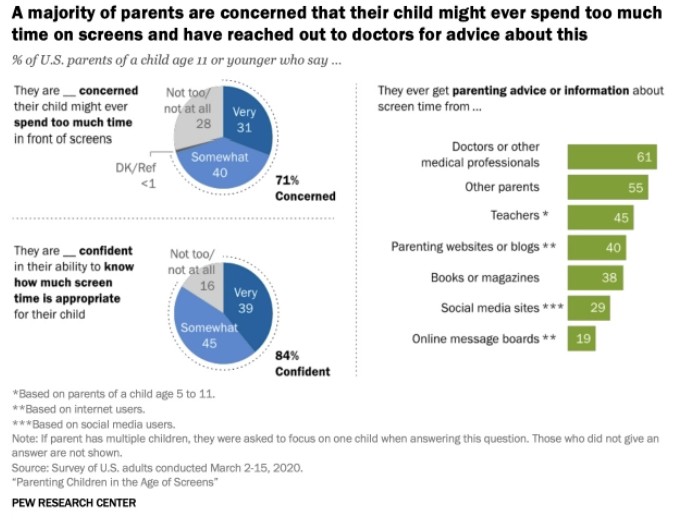
According to a Pew survey (done just before the 2020 lockdowns), many parents are “concerned” to “very concerned” about screen time.
The Shocking Pew Data
To me, the ages of the children in the survey were shocking. Now, I don’t want to get into the old, “When I was that age…” but holy cow! The Pew study says, “Parents overall are also apprehensive about the long-term effects of smartphones on children’s development: 71% believe the widespread use of smartphones by young children might potentially result in more harm than benefits…. For example, 80% of parents say their child age 5 to 11 ever uses or interacts with a tablet computer, while 63% say the same about smartphones. For parents of children under the age of 5 those shares are also notable: 48% and 55%, respectively. At the same time, roughly one-third of parents of a child 11 or younger (36%) say their child ever uses or interacts with a voice-activated assistant, like Apple’s Siri or Amazon Alexa” (emphasis mine).

**FIVE YEARS OLD? FIVE?** I had to read that one twice and add my own emphasis.
Far be it for me to tell someone else how to parent effectively, but holy cow, again, five years old using smartphones or tablets. I see it in the supermarket and other stores - kids watching videos and such. I understand that, to a point. Of course, **moderation is a key!** In this day and age, when we know the addictive qualities of the Internet and social media (this **DEFINITELY INCLUDES YOUTUBE**), we need to continue to educate our patrons on media literacy and usage. Now is not the time to run through the town like the boy who cried wolf, but to engage on a one-on-one level with all of our patrons and advocate for moderation of usage - even if it’s only inside the library!
References
- Auxier, B., Anderson, M., Perrin, A., and Turner, E. (2020). Parenting Children in the Age of Screens. From Pew Research Center Website: https://www.pewresearch.org/internet/2020/07/28/parenting-children-in-the-age-of-screens/.
- Gupta, P. (2020). Tips On How To Limit Your Child's Technology Use. From EdTechReview Website: https://edtechreview.in/trends-insights/insights/4443-tips-on-how-to-limit-your-child-s-technology-use.
- Holmquist, A. (2018). 7 Ways Tech Executives Limit Their Children’s Internet Usage. From Intellectual Takeout Website: https://www.intellectualtakeout.org/article/7-ways-tech-executives-limit-their-childrens-internet-usage/.