The Explosion of Data
Billions of gigabytes of data are created every day on the Internet. The **IDC (International Data Corporation)** is a market research firm that tracks this information, and has created the following infographics:
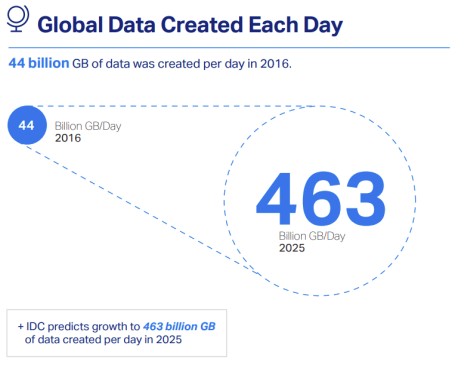
Considering the fact that most web pages are mere kilobytes in size, this means that data creation could account for trillions of new web pages every minute, twenty-four hours a day, seven days a week.
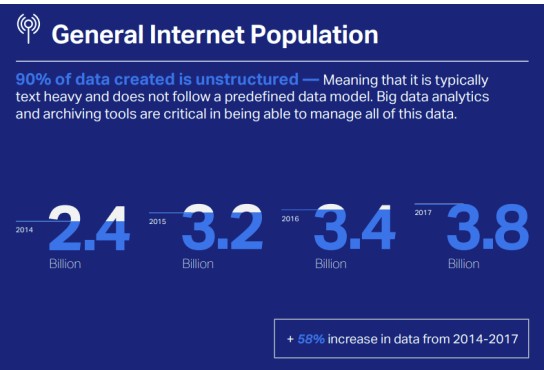
Now, of course it’s not really website creation that’s driving all of this creation and data. It’s the people (us, the users) who are creating the data, and we don’t follow all the metadata and cataloging rules! The IDC calls this **“unstructured data,”** as seen in the infographic above. These are comments, clicks, shares, searches, and even where we “float” our mouse indicators on a screen. If you’d like real-time demonstrations of this go to “Click Click Click.” Quite creepy!
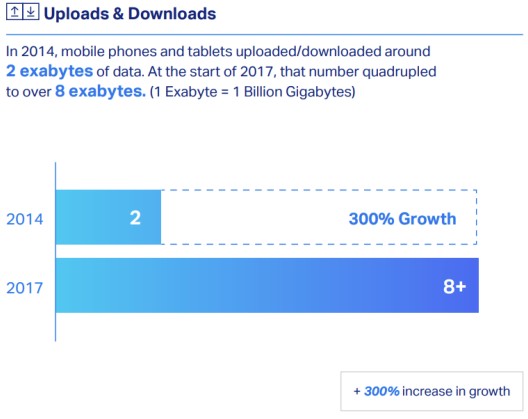
As to **downloads** (information that comes from the Internet “down” to your personal computer device) and **uploads** (data that goes “up” from your device to the Internet), well, that has exploded as well. According to the above picture there was a **300% increase** in growth in data sharing going both ways - but this is from tablets and mobile phones alone. If we include larger computers in businesses, governments, and universities, personal computers, and laptops, and there’s even greater growth.
Social media, too, has exploded. Facebook, Instagram (owned by Facebook), and Twitter have seen millions of new users signing up each day, and Twitter had over 100 million new tweets from 2014 to 2017.
Understanding Exabytes: The True Scale of Storage
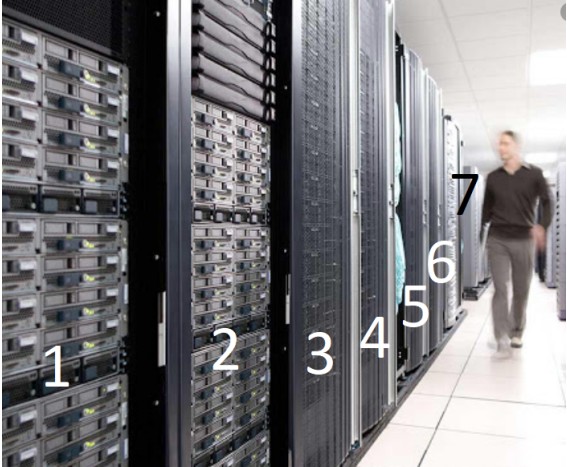
There’s a reason I’m getting into this: We really have no Earthly idea how big the Internet really is, not in our normal lives, whether personal or professional. For those of us lucky enough to have gone on the tour of the Yahoo/Oath data center in 2018, we got to see a tiny fraction of the storage space used regularly for Internet traffic; there was one computer memory unit that was the size of a small closet, or, about the size of a regular Port-a-Potty. It was sitting in the middle of a room, surrounded by other modules just like it. They were basically in storage, waiting to be connected to the Internet.
The engineers that took us on the tour told us that this one module could hold several hundred **EXABYTES** of data.
Here’s roughly what the computer memory unit looked like (person in picture for size comparison):
What is ONE exabyte of data?
What does that even mean, in real life? If we were only considering books, the general consensus is that two (2), 250-page books would fit in one megabyte of storage, and storage is generally multiplied by 1000 to get to the next unit. Here is a comparison of storage units:
| Storage Unit | Equivalent to (x1000) | Rough Book Capacity (250 pages) |
|---|---|---|
| 1 Megabyte (MB) | N/A | 2 Books |
| 1 Gigabyte (GB) | 1,000 MB | 2,000 Books |
| 1 Terabyte (TB) | 1,000 GB | 2,000,000 Books (2 Million) |
| 1 Petabyte (PB) | 1,000 TB | 2,000,000,000 Books (2 Billion) |
| **1 Exabyte (EB)** | 1,000 PB | **2,000,000,000,000 Books (2 Trillion)** |
Now, I can see roughly SEVEN of those storage spaces in this picture, as numbered. Obviously, there are more behind and on the other side. Seven times 2 trillion is **14 TRILLION books**. The entirety of the books contained in every type of library in New York State wouldn’t even take up a fraction of ONE of these storage spaces.
Who Controls the Gateways?
Last major point here, and thank you for staying with me. Where, exactly, are these monster storage spaces? Where are these data centers, and who owns them? I’ll keep this basic:
A company I have never heard of, named **Equinix**, based in California, owns about 11% of the $54 billion market. It is the single largest **colocation provider** in the world. This company provides data centers “where equipment, space, and bandwidth are available for rental to retail customers. Colocation facilities provide space, power, cooling, and physical security for the server, storage, and networking equipment of other firms and also connect them to a variety of telecommunications and network service providers with a minimum of cost and complexity.”
Now, Yevgeniy Sverdlik, writing for the Data Center Knowledge website states, “Following Equinix is **Digital Realty** [in Texas], with 8 percent market share, and following Digital is **China Telecom**, with 6 percent market share. It’s important to note that China Telecom is one of five Chinese companies on the leaderboard, all of whom do business primarily in China. China’s market is so vast that these providers can stay mostly domestic (with some international presence) and still have [a] huge share of the global market.” The rest of the companies listed are spaced out between Japan and the UK.
These are the companies that are controlling our access to the Internet. Who are they? Who controls these companies? It reminds me of the Christopher Reeves/Margot Kidder “Superman” scene:

References
- Data center image found at: http://www.cometaspa.com/en/Markets/Data-Centers/.
- Schultz, J. (2019). How much data is created on the Internet each day? Retrieved from Micro Focus Website: https://blog.microfocus.com/how-much-data-is-created-on-the-internet-each-day/.
- Infographic link: https://www.slideshare.net/Micro-Focus/growth-of-internet-data-2017?from_action=save.
- Superman image found at: https://me.me/i/easy-miss-ive-got-you-youve-got-me-whos-got-21936510.
- Sverdlik, Y. (2021). 2021: These are the World’s Largest Data Center Colocation Providers. Retrieved from Data Center Knowledge Website: https://www.datacenterknowledge.com/archives/2017/01/20/here-are-the-10-largest-data-center-providers-in-the-world.
- Wikipedia. (2021). Colocation Centers. Retrieved from Wikipedia Website: https://en.wikipedia.org/wiki/Colocation_centre.