What do these have in common? Age, Accident, Ancestry?
Ability. Eventually our abilities degenerate to one degree or another. We will all become less abled, or disabled in our lives. This is a fact, and whether or not we want to face it, it is inevitable.
I attended a webinar about library accessibility recently and one thing definitely stood out to me: One presenter mentioned something like, "the disabled community is one we could all become a part of in one way or another." Instead of the word, "could" I'd use the word, "will." Accidents and ancestry/genes play a role, but so does age. I am certainly less-abled now than I was 20 years ago. I watched Parkinson's ravage my father. I see my mother, and others, declining. It drove the point home to me.
I wanted to be sure I was using the best possible language here, so I went poking around and was not disappointed. I was surprised at the US Forest Service page - I thought it was excellent. Quoted from them:
“Though individuals who have disabilities use a variety of terms to refer to themselves, as an agency we must ensure that we use terminology that complies with legal direction and is considered acceptable by the majority of people. With these points in mind, the following guidance is offered. The two terms most commonly used to describe a person who has a limitation are "handicapped" and "disabled." A disability is the result of a medically definable condition that limits a person's movements, senses, or activities. A handicap is a barrier or circumstance that makes progress or success difficult, such as an impassable flight of stairs or a negative attitude toward a person who has a disability.”
A practical example: Janet Zeller, who has quadriplegia (some level of paralysis in all four limbs), has been told that she doesn't look "handicapped" when she is out paddling her sea kayak. Think about the situation. When Janet is paddling her sea kayak she is part of a sleek craft gliding through the water. There are no barriers to stop her or to "handicap" her. But she still has a disability.”
Since this is brilliant in its simplicity, here’s more from the same page: “Accessible means in compliance with the Federal accessibility guidelines and standards. Accessible sites and facilities do not contain barriers limiting their use by people with disabilities. A site, facility, or program is accessible, or it is not accessible. The only way to evaluate accessibility is by using the legal standards and guidelines. There are no shades of accessibility.
For instance, a parking space either meets the requirements and is accessible or it does not meet the requirements and is not accessible. The specific surfacing, slope, size, and walkway connection requirements must be met, regardless of the conditions around the parking space. "Almost" doesn't count.”
How does this affect libraries? In multiple ways, of course. Physical accessibility and digital accessibility should be a given for us. But are they?
As a person who travels from library to library frequently, and often with enough computer equipment that I cannot use the stairs or other “traditional” entrances to our buildings, I appreciate all of our libraries in different ways. I use book carts constantly to move equipment, and so I’m familiar with most of the difficulties of pushing heavy, wheeled paraphernalia. However, like most people, I cheat, too. How? I pick up and move the cart. I unload part of it and walk. Probably most importantly, I recognize the fact that if I make a mistake and the cart tips, I’m not going to injure another person, or myself. After all, if the computers slide down and off the cart, it’s not like the time I almost dumped my father on the ground. Yes, I almost did. We went to a restaurant and, though he stayed upright in the wheelchair, I almost had a heart attack getting him inside. Good thing he had a sense of humor!
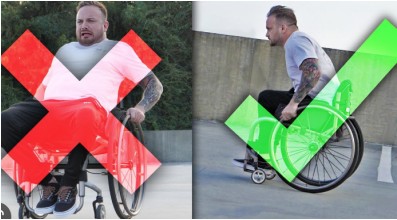
Where were these instructions when I needed them? At Good Wheelchair Weight Distribution.
There are always obstacles I just don’t think of prior to entrance. Interestingly, things like “oversize cracks” are the worst. They are super easy to overlook and never fail to catch wheels.
Take a look at this photo. Both cracks in the sidewalk are easy to overlook. Guess which one is the problem.
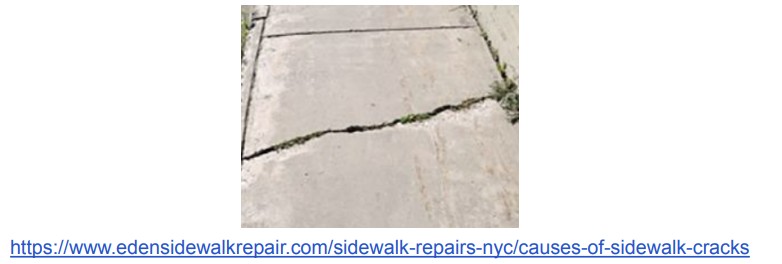
This is not meant to shame any building or library! There will always be issues we can’t address, but doing our best to note these things and making them a priority to our management - directors, boards, or other staff members - is a good thing.
How do you think you can make a difference at your library?
References
- USDA Forest Service, Technology and Development. (2022). Disabled or handicapped or ??? Which terms should be used? Retrieved from USDA Forest Service Article.